
CBD Oil Strength Guide
CBD Oil Strength Guide: How to Choose the Right CBD Oil Potency
Choosing the right CBD product can feel overwhelming, especially with so many different strengths available. Whether you’re new to CBD or looking to switch to a different concentration, understanding CBD potency is an important step toward making an informed decision. This CBD Oil Strength Guide explains how CBD strength works, the different potency levels available, and the factors to consider when selecting a hemp-derived CBD oil.
What Does CBD Oil Strength Mean?
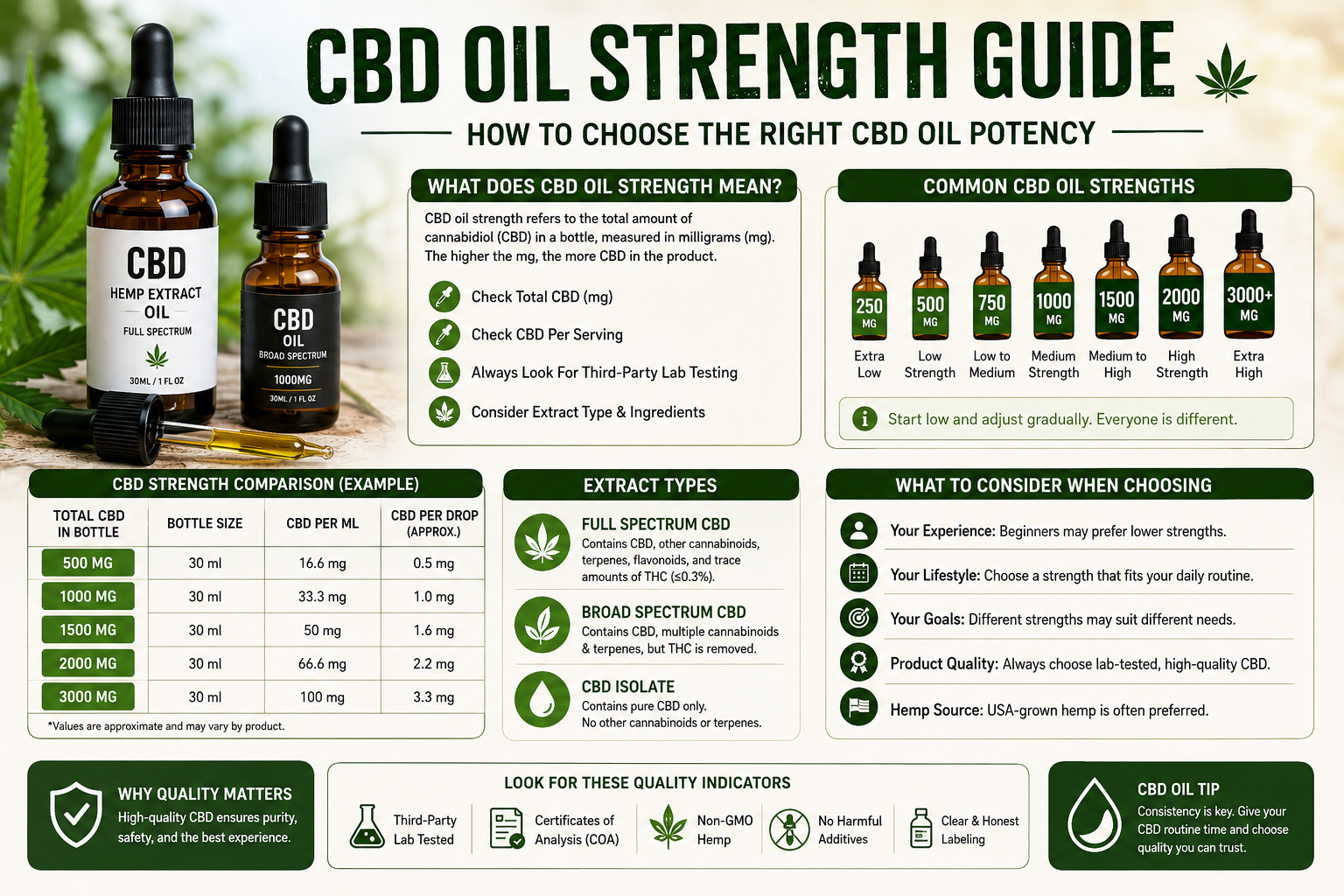
CBD oil strength refers to the total amount of cannabidiol (CBD) contained in a bottle or serving. Manufacturers typically display the total CBD content in milligrams (mg), such as 500 mg, 1000 mg, or 3000 mg. The higher the milligram amount, the more CBD is contained in the product. CBD Oil Strength Guide
For example:
- 500 mg CBD Oil
- 1000 mg CBD Oil
- 1500 mg CBD Oil
- 2000 mg CBD Oil
- 3000 mg CBD Oil
- 5000 mg CBD Oil
- CBD Oil Strength Guide
These numbers represent the total CBD content in the bottle rather than the amount in each drop.
Why CBD Oil Strength Matters
Understanding potency helps consumers compare products more accurately. A stronger CBD oil simply contains more cannabidiol per serving than a lower-strength product.
When comparing products, always consider:
- Total CBD content
- Bottle size
- CBD per serving
- Third-party laboratory testing
- Hemp source
- CBD Oil Strength Guide
These factors provide a clearer picture of the product than looking at the bottle size alone.
Low-Strength CBD Oil
Low-strength CBD oils generally contain between 250 mg and 600 mg of CBD per bottle.
These products are often selected by individuals who:
- Are new to CBD
- Prefer lower-potency formulations
- Want flexibility in serving size
- CBD Oil Strength Guide
Many first-time users begin with lower-strength products while learning how different formulations compare.
Medium-Strength CBD Oil
Medium-strength CBD oils usually range from 700 mg to 1500 mg per bottle.
These products are among the most popular because they provide a balance between concentration and serving flexibility.
Consumers often appreciate medium-strength oils because they offer:
- Greater CBD concentration
- Convenient serving sizes
- Wide product availability
- CBD Oil Strength Guide
High-Strength CBD Oil
High-strength CBD oils typically contain 2000 mg to 5000 mg or more of CBD.
These concentrated formulations provide more CBD per serving compared with lower-strength products.
High-potency products are commonly chosen by consumers who prefer concentrated hemp extracts.
Understanding CBD Per Serving
While total CBD content is important, the amount of CBD per serving provides an even better comparison.
For example:
30 ml Bottle
500 mg CBD
Approximately 16–17 mg CBD per ml
30 ml Bottle
1000 mg CBD
Approximately 33 mg CBD per ml
30 ml Bottle
3000 mg CBD
Approximately 100 mg CBD per ml
Comparing CBD per serving helps consumers understand product concentration more accurately.
Full Spectrum vs Broad Spectrum vs CBD Isolate
CBD oils are available in several extract types. CBD Oil Strength Guide
Full Spectrum CBD
Contains:
- CBD
- Minor cannabinoids
- Terpenes
- Flavonoids
- Trace THC where legally permitted
Broad Spectrum CBD
Contains:
- CBD
- Multiple cannabinoids
- Terpenes
Generally formulated without detectable THC.
CBD Isolate
Contains only purified cannabidiol with no additional hemp compounds.
Understanding extract type is just as important as understanding CBD strength.
Factors That Influence Your Choice
When selecting CBD oil, consider: CBD Oil Strength Guide
Hemp Source
Choose products made from quality hemp grown under strict agricultural standards.
Third-Party Lab Testing
Independent laboratory testing helps verify:
- CBD content
- Cannabinoid profile
- Product purity
Ingredient Transparency
Quality manufacturers clearly list ingredients and provide Certificates of Analysis (COAs).
Product Quality
Look for:
- Good manufacturing practices
- Transparent labeling
- Reputable brands
Common CBD Oil Strengths
Popular CBD strengths include:
- 500 mg
- 750 mg
- 1000 mg
- 1500 mg
- 2000 mg
- 2500 mg
- 3000 mg
- 4000 mg
- 5000 mg
Many manufacturers offer several options to suit different consumer preferences.
How Is CBD Oil Made?
CBD oil begins with hemp plants rich in cannabidiol.
Manufacturers commonly use:
CO₂ Extraction
A widely used process that preserves many natural hemp compounds.
Ethanol Extraction
Another common extraction method.
Both techniques aim to produce high-quality hemp extracts while maintaining cannabinoid integrity.
Why Third-Party Testing Is Important
Always purchase CBD products that provide laboratory reports.
These reports verify:
- CBD concentration
- Cannabinoid profile
- Purity
- Heavy metal screening
- Pesticide screening
- Residual solvent analysis
Independent testing increases transparency and consumer confidence.
Reading CBD Labels
When shopping for CBD oil, check for:
- Total CBD content
- Serving size
- Bottle size
- Hemp source
- Batch number
- Laboratory report availability
- Ingredients
- Expiration date
Understanding product labels makes comparing CBD oils much easier.
Storage Tips
To help maintain product quality:
- Store in a cool, dry place.
- Keep away from direct sunlight.
- Close the bottle tightly after use.
- Avoid excessive heat.
Proper storage helps preserve freshness over time.
Frequently Asked Questions
Is stronger CBD oil always better?
Not necessarily. Higher-strength oils simply contain more CBD per serving. The best choice depends on your preferences and the product you are looking for.
What bottle size is most common?
Most CBD oils are sold in 30 ml bottles, although 15 ml and 60 ml options are also available.
Does Full Spectrum CBD have THC?
Depending on local regulations and product formulation, Full Spectrum CBD may contain trace amounts of THC.
What does “lab tested” mean?
Lab-tested products have been independently analyzed to verify cannabinoid content and product quality.
How can I compare two CBD oils?
Look beyond the bottle size and compare:
- Total CBD
- CBD per serving
- Extract type
- Laboratory testing
- Ingredient quality
Choosing a High-Quality CBD Oil
Whether you’re comparing low-, medium-, or high-strength products, quality should always come first. Select products from reputable manufacturers that provide transparent labeling, third-party laboratory testing, and detailed product information. Understanding the relationship between CBD strength, extract type, and serving concentration allows you to compare products more confidently.
Final Thoughts
This CBD Oil Strength Guide is designed to help consumers better understand CBD potency and product labeling. By learning how different strengths are measured, comparing extract types, and reviewing laboratory reports, you can make more informed decisions when choosing hemp-derived CBD products. Always purchase from reputable brands that prioritize quality, transparency, and compliance with applicable regulations. Whether you choose a lower-strength or higher-strength formulation, understanding CBD oil concentration is the first step toward selecting a product that meets your individual preferences.