
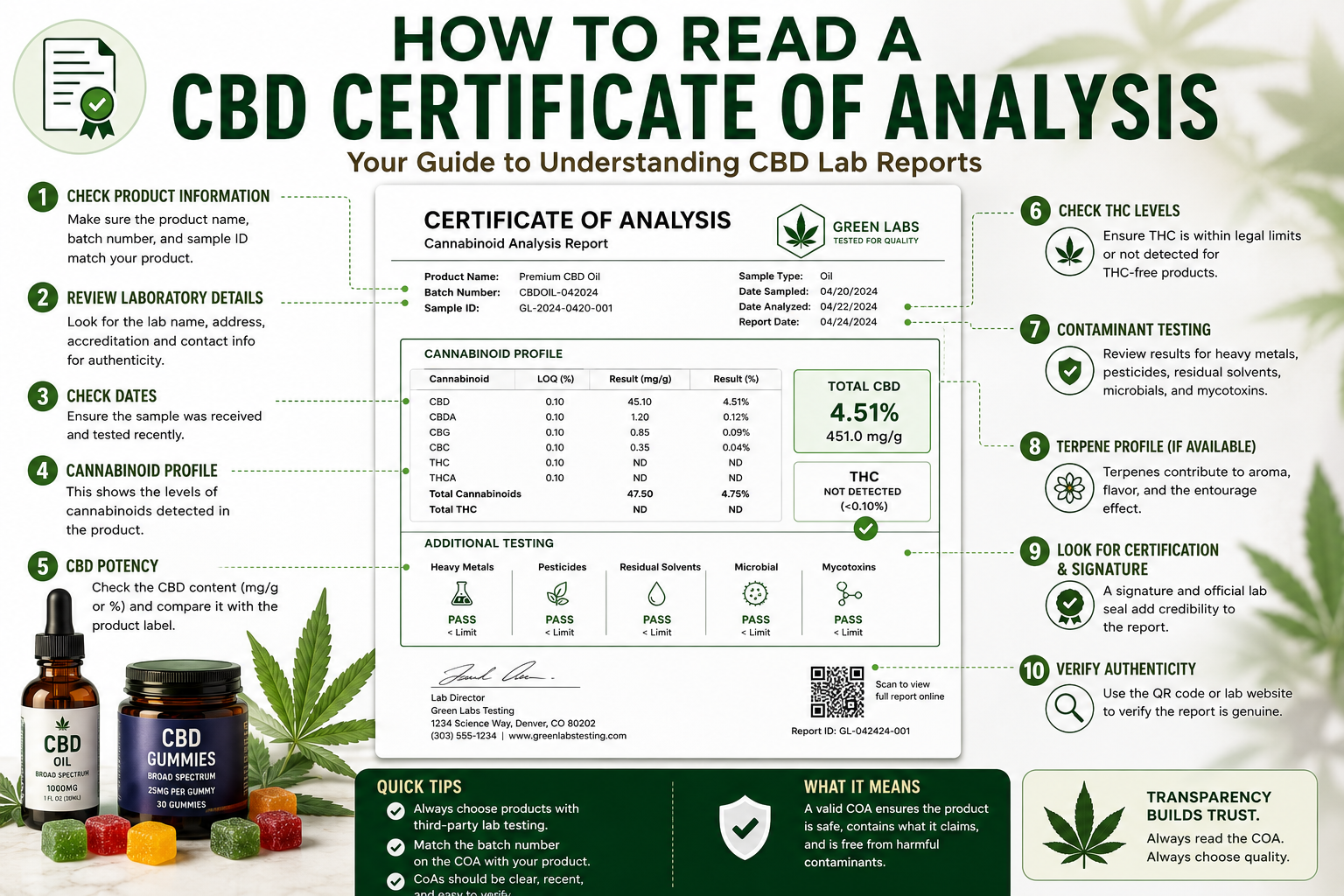
How to Read a CBD Certificate of Analysis
How to Read a CBD Certificate of Analysis: A Complete Guide to Understanding CBD Lab Reports
How to Read a CBD Certificate of Analysis, If you’ve ever purchased a CBD product, you’ve probably noticed companies mentioning a Certificate of Analysis (COA). But what exactly is it, and why does it matter?
Understanding How to Read a CBD Certificate of Analysis is one of the most important skills every CBD consumer should develop. A Certificate of Analysis helps verify the contents of a CBD product, confirms its quality, and provides transparency about what’s inside the bottle, gummy, capsule, or topical you’re considering.
In this comprehensive guide, you’ll learn How to Read a CBD Certificate of Analysis, understand each section of a COA, recognize common testing terms, and know what to look for when choosing premium hemp-derived CBD products.
What Is a CBD Certificate of Analysis?
A Certificate of Analysis (COA) is an independent laboratory report that provides detailed information about a CBD product.
Manufacturers send samples from production batches to third-party laboratories for testing. These laboratories analyze the product and issue a report showing cannabinoid content and, depending on the tests requested, information about contaminants such as heavy metals, pesticides, microbes, and residual solvents. How to Read a CBD Certificate of Analysis
Learning How to Read a CBD Certificate of Analysis helps consumers verify that a product matches its label and has undergone independent testing.
Why Is a CBD Certificate of Analysis Important?
One of the biggest advantages of purchasing premium CBD products is transparency.
A COA helps consumers verify:
- CBD concentration
- Cannabinoid profile
- THC content
- Product consistency
- Batch information
- Laboratory testing
- Product purity
- Manufacturing transparency
Without a Certificate of Analysis, it is difficult to independently verify the information provided on the product label.
What Information Does a COA Include?
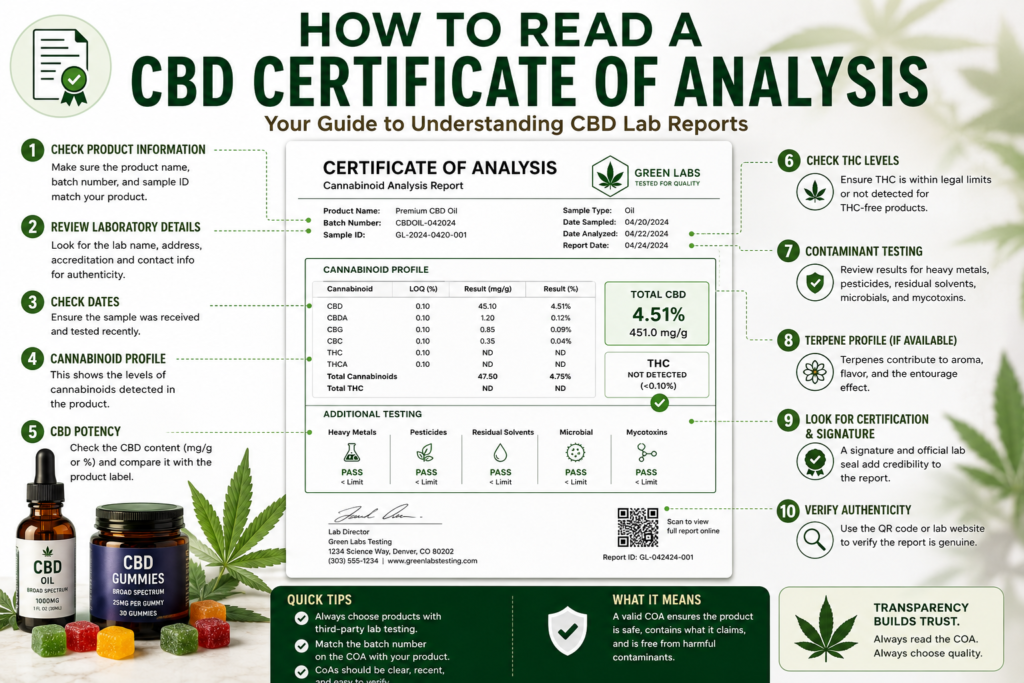
Every laboratory report is slightly different, but most include several standard sections.
Understanding each of these sections is essential when learning How to Read a CBD Certificate of Analysis.
Most reports include:
- Product name
- Manufacturer
- Batch number
- Sample identification
- Date received
- Testing date
- Cannabinoid profile
- Potency analysis
- THC results
- Laboratory information
- Contaminant screening
Step 1: Verify the Product Information
The first thing to examine is whether the report actually belongs to the product you’re purchasing.
Look for:
- Product name
- Batch number
- Lot number
- Sample ID
These details should match the packaging whenever possible.
If the batch number differs, the COA may belong to another production run.
A trustworthy Certificate of Analysis should clearly identify the laboratory that performed the testing.
Look for:
- Laboratory name
- Laboratory address
- Accreditation information
- Contact details
- Report number
Independent third-party laboratories provide greater confidence because they are separate from the manufacturer.
Step 3: Review the Testing Date
Laboratory reports should include important dates such as:
- Sample received
- Sample analyzed
- Report issued
Recent reports are generally more useful than outdated reports because they correspond to newer production batches.
Step 4: Understand the Cannabinoid Profile
The cannabinoid profile is one of the most important sections of a COA.
This section identifies which cannabinoids were detected during laboratory testing.
Common cannabinoids include:
- CBD
- CBDA
- CBG
- CBGA
- CBC
- CBN
- THC
- THCA
Learning How to Read a CBD Certificate of Analysis means understanding that different CBD products contain different cannabinoid profiles.
Broad Spectrum vs Full Spectrum vs CBD Isolate
The cannabinoid profile also helps identify the type of CBD extract.
Broad Spectrum CBD
May contain:
- CBD
- CBG
- CBC
- Terpenes
- Other cannabinoids
while being processed to remove THC.
Full Spectrum CBD
Typically contains:
- CBD
- Minor cannabinoids
- Naturally occurring terpenes
- Trace amounts of THC
CBD Isolate
CBD Isolate generally contains purified CBD with very few additional cannabinoids.
The COA helps verify which extract type matches the product.
Step 5: Check CBD Potency
Potency testing measures the amount of CBD present.
Laboratories often report:
- Milligrams per gram
- Percentage
- Total cannabinoid concentration
Compare these figures with the product label.
For example, if a bottle claims to contain 1000MG CBD, the laboratory report should support that claim within accepted testing tolerances.
Step 6: Review THC Results
One of the most searched sections on a COA is THC testing.
Depending on the product type, the report may show:
- Delta-9 THC
- THCA
- Total THC
Consumers should understand that “THC-Free” marketing claims should ideally be supported by laboratory analysis.
Understanding How to Read a CBD Certificate of Analysis includes checking THC values rather than relying solely on front-label statements.
Step 7: Look for Heavy Metal Testing
Premium CBD manufacturers often screen for heavy metals.
Common metals include:
- Lead
- Mercury
- Cadmium
- Arsenic
The report should indicate whether these substances passed acceptable testing limits.
Step 8: Examine Pesticide Testing
Because hemp absorbs compounds from soil, pesticide testing is another important quality indicator.
Laboratories may test for numerous agricultural chemicals.
Reports typically show:
- Pass
- Not Detected
- Below Limit
- Acceptable Level
Independent pesticide testing provides additional product transparency.
Step 9: Review Residual Solvent Testing
CBD extraction methods sometimes involve solvents.
Testing may screen for substances such as:
- Ethanol
- Butane
- Propane
- Hexane
- Pentane
Many premium manufacturers use extraction methods designed to minimize solvent residues while still providing batch-specific testing.
Step 10: Check Microbial Testing
Microbial testing helps identify biological contaminants.
Common screening may include:
- Yeast
- Mold
- Salmonella
- E. coli
- Total aerobic bacteria
Products should meet laboratory safety standards.
Step 11: Mycotoxin Screening
Some laboratories also perform mycotoxin analysis.
These naturally occurring compounds may develop under certain storage conditions.
Premium manufacturers often include this testing as part of broader quality assurance programs.
Step 12: Terpene Analysis
Some Certificates of Analysis include terpene profiles.
Common terpenes include:
- Myrcene
- Limonene
- Pinene
- Caryophyllene
- Linalool
- Humulene
Terpenes contribute to the natural aroma of hemp extracts and help characterize the product’s botanical profile.
Common Terms Found on a COA
When learning How to Read a CBD Certificate of Analysis, you’ll frequently encounter laboratory terminology.
ND (Not Detected)
The laboratory did not detect the compound above its reporting threshold.
LOQ (Limit of Quantification)
The lowest concentration the laboratory can reliably measure.
LOD (Limit of Detection)
The smallest amount detectable by the laboratory.
Pass
The sample meets laboratory acceptance criteria.
Fail
The sample exceeded the laboratory’s established limits.
Understanding these terms makes laboratory reports easier to interpret.
Red Flags to Watch For
Not every CBD product provides reliable documentation.
Be cautious if:
- No COA is available
- The report lacks a batch number
- Testing dates are outdated
- Laboratory information is missing
- CBD content differs greatly from the label
- THC information is absent
- The report appears incomplete
Transparent companies typically make their laboratory reports readily available.
Tips for Choosing High-Quality CBD Products
After learning How to Read a CBD Certificate of Analysis, use these best practices when evaluating CBD products:
- Look for independent third-party testing.
- Verify the batch number.
- Compare CBD content with the product label.
- Review THC results.
- Examine contaminant testing.
- Read the complete ingredient list.
- Purchase from transparent manufacturers.
These steps help consumers make informed purchasing decisions.
Frequently Asked Questions
What is a CBD Certificate of Analysis?
A Certificate of Analysis is an independent laboratory report verifying cannabinoid content and product testing results.
Why should I check a COA?
A COA provides transparency and helps verify that the product matches its labeling.
Is every CBD product lab tested?
Not necessarily. Reputable manufacturers generally provide third-party laboratory reports, but availability varies.
What does “Not Detected” mean?
It means the laboratory did not detect that substance above its established reporting threshold.
Does a COA guarantee product quality?
A COA provides valuable laboratory information, but it should be considered alongside ingredient transparency, manufacturing practices, and company reputation.
Final Thoughts
Learning How to Read a CBD Certificate of Analysis empowers consumers to make more informed choices when evaluating CBD products. Rather than relying solely on marketing claims, a COA provides independent laboratory information about cannabinoid content, potency, THC levels, and selected contaminant testing.
When reviewing a CBD product, always verify the batch number, examine the cannabinoid profile, compare the reported CBD concentration with the label, review THC results, and look for evidence of third-party testing. These simple steps can help you identify transparent manufacturers and better understand the products you are considering.
By mastering How to Read a CBD Certificate of Analysis, you’ll be better equipped to interpret lab reports, evaluate product quality, and confidently compare CBD oils, gummies, capsules, and other hemp-derived wellness products.