
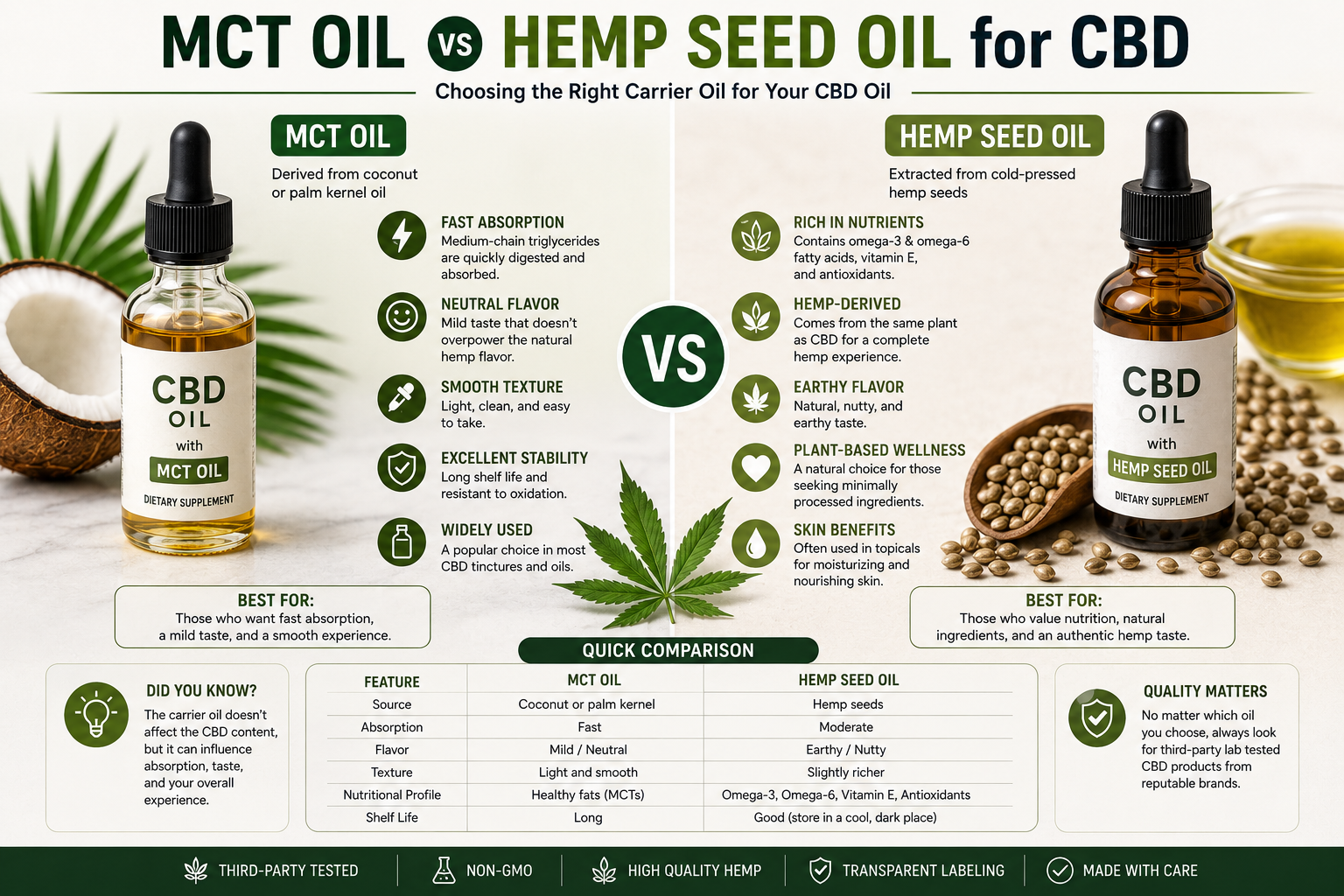
MCT Oil vs Hemp Seed Oil for CBD
MCT Oil vs Hemp Seed Oil for CBD: Which Carrier Oil Is Better?
When shopping for CBD oil, most people focus on the amount of cannabidiol listed on the label. However, one of the most important ingredients is often overlooked—the carrier oil. The carrier oil plays a crucial role in how CBD is delivered, absorbed, and experienced.
Two of the most common carrier oils used in CBD products are MCT oil and hemp seed oil. While both are excellent options, they have different nutritional profiles, absorption rates, flavors, and ideal use cases.
In this comprehensive guide, we’ll compare MCT Oil vs Hemp Seed Oil for CBD, explain their advantages and disadvantages, and help you determine which carrier oil best suits your wellness goals.
What Is a Carrier Oil in CBD?
CBD extract is highly concentrated and cannot be consumed in its raw form for most tincture products. Manufacturers dilute the extract with a carrier oil to improve:
- Absorption
- Serving consistency
- Shelf stability
- Ease of use
- Flavor and texture
Carrier oils also make it easier to measure and administer CBD accurately.
What Is MCT Oil?
MCT stands for Medium-Chain Triglycerides, a type of fat commonly derived from coconut oil or palm kernel oil.
Unlike long-chain fats, MCTs are absorbed and metabolized more quickly by the body. This rapid absorption is one reason why MCT oil has become a popular carrier for CBD tinctures.
MCT oil is widely used in:
- CBD oils
- Nutritional supplements
- Sports nutrition
- Keto-friendly products
- Functional beverages
Benefits of MCT Oil for CBD
1. Faster Absorption
One of the biggest reasons manufacturers choose MCT oil is its rapid digestion and absorption.
Because medium-chain triglycerides are processed differently from many other fats, they can help carry CBD efficiently through the digestive system.
2. Neutral Flavor
MCT oil has a mild taste that doesn’t overpower the natural flavor of hemp extract.
This makes it an excellent option for people who dislike strong earthy flavors.
3. Smooth Texture
CBD tinctures made with MCT oil often have a light, smooth consistency.
MCT Oil vs Hemp Seed Oil for CBD
Many users find them pleasant to take directly under the tongue.
MCT Oil vs Hemp Seed Oil for CBD
4. Excellent Stability
MCT oil has a relatively long shelf life compared with some plant oils.
Its stability helps maintain product quality when stored correctly.
5. Widely Used
Many premium CBD brands use MCT oil because it mixes well with cannabinoids and creates a consistent product.
What Is Hemp Seed Oil?
Hemp seed oil is extracted by cold-pressing the seeds of the hemp plant.
Unlike CBD extract, hemp seed oil naturally contains very little or no CBD. Instead, it is valued for its nutritional profile.
Hemp seed oil contains:
- Essential fatty acids
- Omega-3 fatty acids
- Omega-6 fatty acids
- Vitamin E
- Natural antioxidants
- Plant sterols
- MCT Oil vs Hemp Seed Oil for CBD
It has been used in foods, skincare products, and nutritional supplements for many years.
Benefits of Hemp Seed Oil for CBD
1. Rich Nutritional Profile
Hemp seed oil contains healthy fats that support overall nutrition.
It is especially appreciated for its balance of omega-3 and omega-6 fatty acids.
2. Naturally Derived from Hemp
Many consumers appreciate using a CBD product in which both the CBD extract and the carrier oil come from the hemp plant.
This creates a cohesive hemp-based formulation.
MCT Oil vs Hemp Seed Oil for CBD
3. Earthy Flavor
Hemp seed oil has a distinctive nutty and earthy taste.
Some CBD enthusiasts enjoy this authentic hemp flavor.
4. Plant-Based Wellness
Hemp seed oil is often chosen by people looking for minimally processed, plant-based ingredients.
5. Skin Benefits
Hemp seed oil is also commonly used in topical products because of its moisturizing properties and lightweight texture.
MCT Oil vs Hemp Seed Oil for CBD: Key Differences
| Feature | MCT Oil | Hemp Seed Oil |
|---|---|---|
| Source | Coconut or palm kernel | Hemp seeds |
| CBD Content | None | None or negligible |
| Absorption | Fast | Moderate |
| Flavor | Mild | Earthy and nutty |
| Texture | Smooth | Slightly richer |
| Nutritional Value | Healthy fats | Rich in omega fatty acids and vitamin E |
| Shelf Life | Long | Good with proper storage |
| Common Use | CBD tinctures | CBD oils and topicals |
Which Carrier Oil Helps CBD Absorb Better?
Many CBD manufacturers use MCT oil because it is rapidly digested and blends well with cannabinoids. This has led to the belief that it may support efficient delivery of CBD.
Hemp seed oil also serves as an effective carrier, though it is often chosen more for its nutritional profile and natural hemp origin than for speed of absorption.
It’s important to remember that CBD absorption depends on several factors, including:
- Product formulation
- Serving method
- Individual metabolism
- Whether CBD is taken with food
- The specific extract used (isolate, broad spectrum, or full spectrum)
- MCT Oil vs Hemp Seed Oil for CBD
Taste Comparison
MCT Oil
- Mild
- Almost flavorless
- Smooth finish
- Easy for beginners\
- MCT Oil vs Hemp Seed Oil for CBD
Hemp Seed Oil
- Earthy
- Nutty
- Strong hemp flavor
- Popular among hemp enthusiasts
- MCT Oil vs Hemp Seed Oil for CBD
If you’re sensitive to taste, MCT oil may be the more appealing option.
Nutritional Comparison
While MCT oil is prized for its quick metabolism, hemp seed oil stands out for its broader nutritional profile.
MCT Oil Contains
- Medium-chain fatty acids
- Easily metabolized fats
- MCT Oil vs Hemp Seed Oil for CBD
Hemp Seed Oil Contains
- Omega-3
- Omega-6
- Gamma-linolenic acid (GLA)
- Vitamin E
- Antioxidants
- Plant sterols
- MCT Oil vs Hemp Seed Oil for CBD
Both oils can fit into a balanced lifestyle, but they contribute different nutritional characteristics.
Which Carrier Oil Is Better for CBD?
The answer depends on your priorities.
Choose MCT Oil If You Want
- A mild flavor
- A light texture
- Fast absorption
- Easy-to-use tinctures
- A widely used CBD formulation
- MCT Oil vs Hemp Seed Oil for CBD
Choose Hemp Seed Oil If You Prefer
- A hemp-derived carrier oil
- Nutritional fatty acids
- A natural hemp taste
- Less processed ingredients
- An all-hemp product concept
Neither option is universally better—each serves different preferences and product goals.
Can Hemp Seed Oil Replace CBD?
No.
This is one of the biggest misconceptions in the hemp industry.
Hemp seed oil and CBD oil are not the same product.
Hemp seed oil comes from hemp seeds and contains little to no CBD.
CBD oil is made from the flowers, leaves, and aerial parts of the hemp plant, where cannabinoids are concentrated.
A CBD product containing hemp seed oil as the carrier still relies on a separate hemp extract to provide cannabidiol.
Why Many CBD Brands Use MCT Oil
There are several practical reasons manufacturers often choose MCT oil:
- Consistent texture
- Neutral taste
- Excellent cannabinoid compatibility
- Good shelf stability
- Consumer familiarity
- MCT Oil vs Hemp Seed Oil for CBD
These qualities make it a popular choice for tinctures intended for daily use.
Why Some Brands Choose Hemp Seed Oil
Hemp seed oil appeals to brands that emphasize natural, hemp-based ingredients.
Benefits include:
- Plant-derived nutrition
- Distinctive hemp flavor
- Complementary use alongside hemp extract
- Consumer preference for hemp-focused formulations
Does the Carrier Oil Affect CBD Quality?
The carrier oil does not determine the quality of the CBD extract itself, but it can influence the overall product experience.
High-quality CBD products should also include:
- Third-party laboratory testing
- Transparent ingredient lists
- Accurate cannabinoid labeling
- Good manufacturing practices (GMP)
- Accessible Certificates of Analysis (COAs)
These factors are more important indicators of product quality than the carrier oil alone.
Frequently Asked Questions
Is MCT oil better than hemp seed oil for CBD?
MCT oil is often chosen for its mild flavor and rapid absorption, while hemp seed oil is valued for its nutritional profile and natural hemp origin. The better choice depends on your preferences.
Does hemp seed oil contain CBD?
No. Hemp seed oil naturally contains little to no CBD. CBD must be extracted from other parts of the hemp plant.
Why is MCT oil commonly used in CBD tinctures?
MCT oil has a neutral taste, smooth texture, good stability, and mixes well with CBD, making it a popular carrier oil.
Can I use either type every day?
Many people incorporate CBD products with either carrier oil into their daily wellness routine. Follow the manufacturer’s serving instructions and consult a healthcare professional if you have questions about adding CBD to your routine.
Which tastes better?
This is subjective. MCT oil has a mild, nearly flavorless taste, while hemp seed oil has a richer, earthy flavor that some people enjoy.
Final Thoughts
When comparing MCT Oil vs Hemp Seed Oil for CBD, there is no single winner. Each carrier oil offers unique advantages that can enhance your CBD experience in different ways.
MCT oil is popular for its smooth texture, neutral flavor, and compatibility with CBD tinctures, making it a great choice for users who prefer a lighter taste and convenient daily use.
Hemp seed oil, on the other hand, appeals to those who value a nutrient-rich, hemp-derived ingredient with a natural, earthy flavor and a strong connection to the hemp plant.
Regardless of which carrier oil you choose, focus on purchasing CBD products from reputable manufacturers that provide third-party testing, transparent labeling, and high-quality hemp extracts. By understanding the role of carrier oils, you can make a more informed decision and select a CBD product that aligns with your wellness goals.